
 EN
EN
EV Charger Type and Power Output: Understanding kW, Voltage, and Amperage
How Kilowatt (kW) Rating Directly Determines Charging Speed
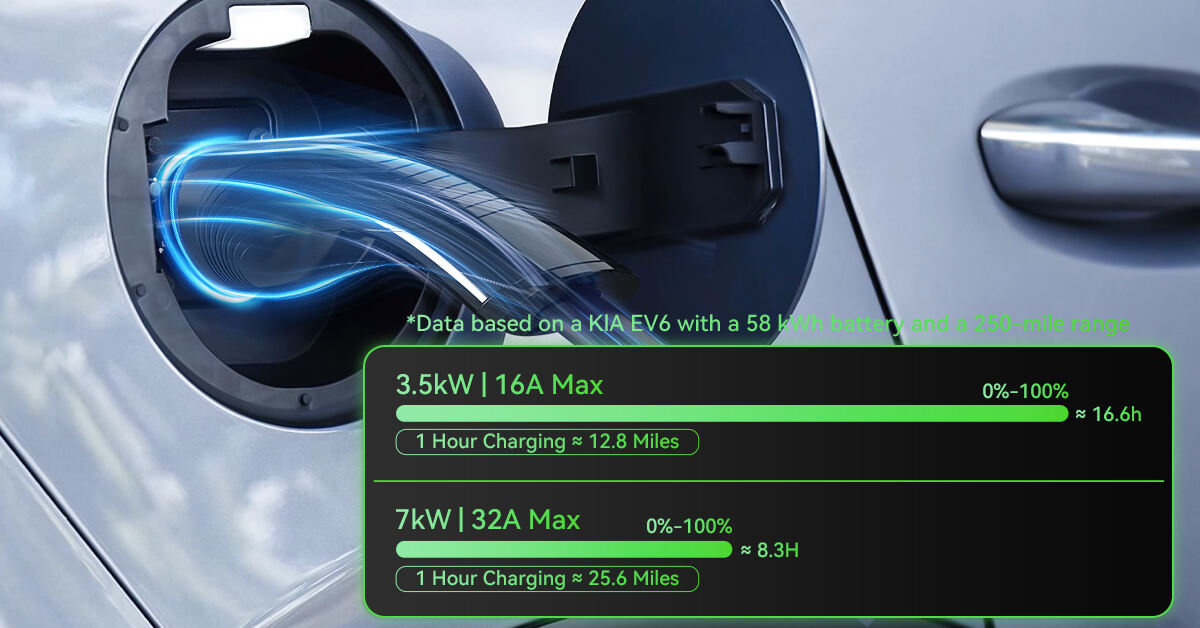
The power rating of an electric vehicle charger measured in kilowatts (kW) has a big impact on charging speed. Chargers with higher kW ratings simply move electricity into the battery faster. Take for instance a standard Level 2 charger rated at 19.2 kW versus the basic Level 1 unit that only puts out around 1.4 kW. The difference is huge - about thirteen times more power flowing in each hour. That's why those fancy DC fast chargers that go from 50 all the way up to over 350 kW can give vehicles well over 200 miles of driving range within just half an hour. Compare this to the slow trickle of Level 1 charging which adds only 3 to 5 miles every hour.
The Role of Voltage and Amperage in Power Delivery (kW = V – A)
The amount of power available for charging depends on both voltage (measured in volts) and current (in amps). The basic calculation goes something like this: kilowatts equals volts multiplied by amps divided by 1,000. When we talk about higher voltage systems, they actually lose less energy during transmission because resistance works against them less. That means electricity gets delivered more efficiently overall. Take a look at what happens when someone doubles the voltage from around 400 volts up to about 800 volts while keeping the same 300 amp current flowing. Suddenly, instead of getting roughly 120 kilowatts out of the system, we're looking at nearly double that at around 240 kilowatts. This is why many companies working in the electric vehicle space are focusing so much attention on upgrading their voltage capabilities these days. They want better charging performance without having to deal with all those thick, heavy cables that come with higher current requirements.
AC vs DC Charging: Differences in Power Delivery and Efficiency
Standard AC chargers work by using the car's built-in converter to switch AC power into DC for charging batteries, which keeps charging speeds capped around 19.2 kW max. DC fast chargers take a different approach entirely though, they skip the onboard conversion step and deliver DC directly to the battery, allowing much faster charging rates that can go beyond 350 kW in some models. The downside? These DC systems tend to waste about 10 to 15 percent of their energy as heat when running at full capacity. Meanwhile most good quality AC chargers hang onto around 85 to 90 percent efficiency during regular use without pushing things too hard. So there's definitely a tradeoff between speed and efficiency depending on what kind of charger someone needs for their daily driving habits.
Real-World Comparison: Home vs Public EV Charger Output
| Charger Type | Power Range | Voltage | Typical Full Charge Time (60 kWh Battery) |
|---|---|---|---|
| Level 1 (Home) | 1.4–1.9 kW | 120V AC | 25–45 hours |
| Level 2 (Home/Public) | 7.7–19.2 kW | 208–240V AC | 4–10 hours |
| DC Fast (Public) | 50–350 kW | 400–1000V DC | 20–60 minutes (80% charge) |
Recent analyses show DC fast chargers now constitute 38% of public stations, reflecting growing demand for high-speed charging. Level 2 remains dominant for home installations due to lower infrastructure costs and compatibility with most residential electrical systems.
Vehicle-Level Factors: Onboard Charger Limits and Battery Characteristics
Onboard Charger Capacity as a Bottleneck for AC Charging Speeds
Most electric vehicles come equipped with onboard chargers that range from around 3.3 kW all the way up to 22 kW. These onboard units basically set the upper limit for how fast the car can charge using alternating current, no matter what kind of wall socket or charging station it's plugged into. Take a look at this scenario: if someone connects their EV to a powerful 19.2 kW Level 2 charger but their car only has a 7.4 kW onboard charger, they'll still only get about 30 extra miles of driving range each hour. Car manufacturers have started putting in bigger onboard chargers lately, usually somewhere between 19 and 22 kW. This change helps cut down on those long home charging sessions by roughly half, although nothing comes close to matching the speed of direct current fast charging stations found at public locations.
Battery State of Charge (SOC) and Its Impact on Charging Curve Efficiency
The charging pattern for lithium ion batteries isn't straightforward at all. They actually take in the most power when they're almost empty, but once they get past about 80% state of charge, things start slowing down quite a bit. When those cells near their voltage ceiling around 4.2 volts, the charger has no choice but to cut back on current flow somewhere between half and two thirds to keep them from getting too hot. Take a look at what happens at room temperature, say around 20 degrees Celsius or 68 Fahrenheit. A battery could be taking in 150 kilowatts of power when it's just 20% charged, but drop to only 35 kilowatts by the time it reaches 85%. That means the last part of the charging process takes way longer than people expect, which can be frustrating for anyone waiting on their device to fully charge.
Battery Health Degradation Over Time and Reduced Peak Charging Rates
As batteries age over time, they tend to hold less power and charge at a slower pace. According to research published by the Idaho National Laboratory in 2023, lithium ion battery packs typically see around a 15 to 20 percent drop in maximum charging speed after about eight years of use. This happens because several things go wrong inside the battery cells. The SEI layer gets thicker, there's lithium plating on electrodes, and mechanical stress builds up from repeated charging cycles. All these issues make it harder for ions to move through the battery, which means internal resistance goes up while available ions decrease. What does this actually look like in practice? Well, take DC fast charging as an example. A brand new battery might fill up in just 28 minutes, but after driving roughly 100,000 miles, those same charging sessions can stretch out between 37 minutes or even longer depending on how much degradation has occurred.
Battery Chemistry Differences: NMC vs LFP Charging Behavior
| Characteristic | NMC | LFP |
|---|---|---|
| Voltage Range | 3.0–4.2V | 2.5–3.65V |
| Peak Charging Rate | 2–3C (Higher) | 1–2C (Lower) |
| Thermal Sensitivity | Requires active cooling | Tolerates passive cooling |
While NMC batteries support faster charging under ideal conditions, LFP chemistries retain 90% of their original charging speed after 3,000 cycles—significantly outperforming NMC's 75% retention over the same period.
Environmental and Infrastructure Influences on EV Charging Performance
Cold Weather Effects on Battery Efficiency and Charging Speed (Up to 40% Slower)
When temps drop below 50 degrees Fahrenheit (around 10 Celsius), something interesting happens inside lithium ion batteries. The internal resistance goes up, which basically means electrons have a harder time moving around, and this can cut down on charging speed anywhere from about 20 percent all the way to 40 percent slower. According to research published last year in the industry journal, electric vehicles take roughly 30% longer to get to that sweet spot of 80% state of charge when parked outside in freezing conditions compared to nice warm weather around room temperature. To combat this issue, modern battery management systems actually start limiting how much power gets fed into the cells. They do this because there's something called lithium plating that becomes a bigger problem when it's cold out, and nobody wants their expensive battery pack degrading faster than necessary.
Thermal Management and Battery Preconditioning Strategies
To counteract cold-weather limitations, modern EVs use two key strategies:
- Active thermal management: Circulates heated coolant through the battery pack to maintain an optimal 68–95°F (20–35°C) operating range
- Navigation-integrated preconditioning: Automatically warms the battery using route data when heading to a DC fast charger
When activated, these systems reduce cold-related delays by 50–70%, though they consume 3–5% of total energy during operation.
Grid Stability, Circuit Load, and Home Electrical Setup for Optimal Level 2 Charging
Residential charging performance depends on consistent grid voltage and adequate circuit capacity. For reliable Level 2 operation:
| Electrical Parameter | Minimum Requirement | Optimal Performance Threshold |
|---|---|---|
| Voltage Stability | 228–252V | 235–245V (±2%) |
| Circuit Capacity | 40A | 50A (20% buffer) |
Installing a smart load management system prevents voltage drops during high-demand periods, maintaining 92–97% charging efficiency compared to 78–85% in unmanaged setups.
Cable Quality and Connection Reliability in Energy Transfer
Charging cables that aren't properly maintained are actually responsible for around 12 to maybe even 18 percent of all efficiency problems at public charging stations. There are several common problems we see regularly. The connectors tend to oxidize over time, which cuts down on conductivity somewhere between 15% and 30%. Insulation cracks happen too, and when that occurs it leads to wasted heat. And let's not forget about those worn out latches that just don't make complete connections anymore. On the flip side, premium quality cables featuring gold plated contacts along with liquid cooled handles can keep energy transfer efficiency above 99%, something absolutely essential for these high powered 350 kW DC fast charging systems that are becoming so popular nowadays.
Charging Network Trends and User Optimization Strategies
Growth of DC Fast Charging Networks and Accessibility Improvements
The world of electric vehicle charging is changing fast these days. Experts estimate that DC fast charging stations could push the global market value past $221 billion by 2034. Along major highways, we're seeing these powerful charging hubs pop up everywhere now, some capable of delivering between 150 and 350 kilowatts. That means drivers can top off their batteries during road trips in just 15 to 20 minutes instead of waiting hours. Cities are also getting smart about this whole thing. Curbside DC chargers are appearing across town centers, connected to smartphone apps where people can book spots, pay for charging, and check if a station is actually free when they arrive. Makes sense really, since nearly half (around 43%) of apartment dwellers don't have private garages and need access to public charging options most of the time.
Maximizing Charging Speed: Best Practices for Home and Public Charging
To optimize charging performance and cost-efficiency, drivers should:
- Schedule home charging during off-peak hours (typically 12 AM–6 AM), when electricity rates drop by 18–25%
- Use vehicle preconditioning to warm or cool the battery before DC fast charging
- Limit public charging sessions to the 20–80% SOC range where peak charging rates are sustained
These practices can cut average charging costs by 30% while supporting long-term battery health.
Future Outlook: High-Speed Charging Advancements and Vehicle-to-Grid Integration
The latest wave of hyperchargers ranging from 500 to 900 kW is currently undergoing tests, and they claim to recharge an electric vehicle enough for about 200 miles in under ten minutes. At the same time, car manufacturers are moving their electrical systems up to 800 volts instead of sticking with the old 400 volt standard. This change cuts down on wasted energy quite a bit actually around half again what was lost before. Then there's this thing called Vehicle-to-Grid or V2G tech that's starting to gain traction. What makes it interesting is how one EV battery could keep lights on in a regular household for somewhere between twelve to eighteen hours if the power goes out. Some folks even estimate these cars might earn owners around $120 to maybe $200 extra each year just by helping balance the electricity grid when needed. All these developments mean electric vehicles aren't just transportation anymore they're becoming rolling power sources that fit right into our changing energy landscape.
FAQ Section
What does kW rating indicate for EV chargers?
The kW rating of EV chargers indicates the power capacity and directly affects how fast your vehicle can be charged.
How do voltage and amperage contribute to EV charging?
Voltage and amperage are factors in determining the total power delivery of the charger, which can be calculated using the formula: kW equals volts multiplied by amps divided by 1,000.
Why do AC and DC chargers have different efficiencies?
AC chargers are typically less efficient than DC fast chargers because they rely on conversions within the car which caps their speed, while DC chargers deliver power directly to the vehicle's battery.
How does weather impact EV charging performance?
Cold weather can reduce charging speed by increasing internal resistance in lithium ion batteries, slowing down the charging process potentially by 20-40%.
What is thermal management in EVs?
Thermal management in EVs involves systems that regulate the battery's temperature to maintain optimal conditions and avoid delays in charging.
How can I optimize my charging speed at home?
Optimize your home charging speed by scheduling it during off-peak hours and ensuring your home's electrical system is properly configured for Level 2 charging.